- Image Categorization and Retrieval
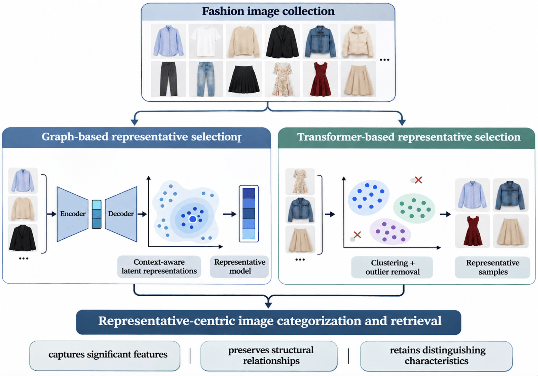
In this project, I developed a representative-centric methodology for fashion image categorization and retrieval, building on a similar approach I had previously introduced to address CAD model comparison [1]. Within this methodology, we construct abstract representative models that capture significant features, structural relationships, and distinguishing characteristics of images and image categories. This allows comparisons to focus on the most relevant information while reducing the computational cost of categorization and retrieval in large image databases. Based on this approach, we introduced two AI implementations to identify representative samples that preserve the distinctive characteristics and variability of fashion items: a graph-based approach that uses Graph Attention Network (GAT) autoencoders to construct context-aware latent representations [2], and a transformer-based approach that combines pre-trained visual embeddings with clustering and outlier removal techniques [3]. Our results demonstrate that representative-based modelling can substantially reduce the search space and computational cost while maintaining retrieval accuracy. Comparable retrieval performance was achieved using only 10% of the original image database.
References
- On verification of interoperability of CAD systems with a focus on invariant properties, D Sap, V Shapiro, Computer-Aided Design 115, 256-266, 2019.
- Image Categorization and Search via GAT Autoencoder and Representative Models, D. Sap, M. Lotz, C. Mattinson, arXiv:2510.16514, 2025.
- Performance-Efficiency Trade-off for Fashion Image Retrieval, J Hurtado, H Ni, D Sap, C Mattinson, M Lotz, Frontiers in Artificial Intelligence and Applications, Volume 413: ECAI 2025, 5264 – 5271, 2025.
- Sensor Visualization (SensorViz)
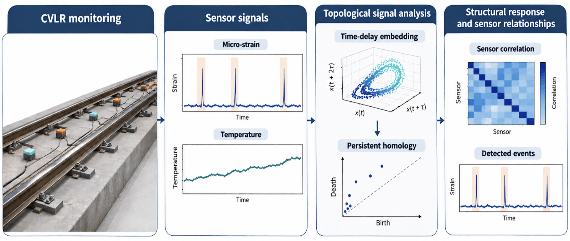
In this project, I developed a mathematical and computational approach to analyzing and visualizing multivariate sensor data, with a particular focus on structural health monitoring and the dynamics of engineering systems. The methodology combines topological data analysis (TDA), time-delay embeddings, persistent homology, and statistical correlation techniques to investigate temporal patterns, identify significant physical events, and examine relationships between measurements obtained from different sensors. I applied these methods to micro-strain and temperature data collected by our collaborators at WMG from sensors installed along the Coventry Very Light Rail (CVLR) infrastructure, investigating structural responses to passing vehicles, variations in loading conditions, and train braking events. By reconstructing the underlying dynamics of sensor signals and examining their topological characteristics, I worked on identifying changes in system behavior that may not be readily apparent through conventional time-series analysis. I also examined correlations between measurements from sensors at different locations to better understand how structural responses vary across the rail infrastructure and to inform potential improvements in sensor placement and system design. The project demonstrates the potential of combining mathematical methods from topology, dynamical systems, and statistics to extract information from complex sensor datasets, supporting structural monitoring, system assessment, and engineering decision-making.
References
- Topological Signal Analysis of Strain and Temperature Data, D. Sap, J. Brettschneider, S. Sharma, D. Hughes, CAMaCS Technical Report, 2025.
- 3D Visualization via Morgan Panel Maps (MPMs)
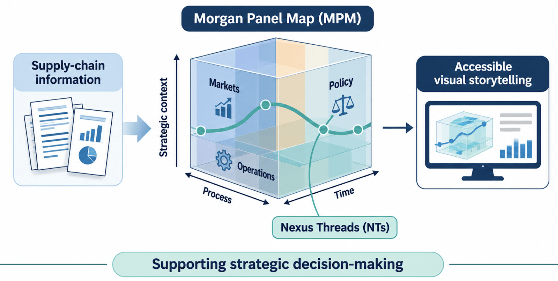
Within the scope of this project, I provided consultancy to researchers at WMG on mathematical and computational approaches to enhancing data visualization and supporting strategic decision-making across complex supply chains in the rare-earth magnet, heat-pump, and steel sectors [1,2,3]. I recommended strategies to improve the structure, accessibility, and presentation of information within 3D visualization tools named Morgan Panel Maps (MPMs) and their associated narratives, called Nexus Threads (NTs). I proposed approaches to simplifying complex visual representations while preserving relevant relationships and context, including dimensionality reduction through 2D projections and level sets, as well as layered 3D representations offering varying levels of detail tailored to the audience’s interests and objectives. In collaboration with another group at WMG, we also explored the use of advanced tools for immersive and interactive storytelling, including Unreal Engine and Unity, alongside alternatives such as Twine and Ren’Py. In addition, I proposed computational workflows using Python libraries to extract and structure information from existing documents for integration into visualization platforms. These recommendations aimed to improve the interpretability, flexibility, and accessibility of multidimensional visualizations, facilitating the exploration of supply-chain relationships and the communication of information relevant to strategic decision-making.
References
- Technical Report on MPM: Scrap Steel, D. Sap, T. Morgan, 2025.
- Technical Report on MPM: Domestic Heat Pump, D. Sap, T. Morgan, 2025.
- Technical Report on MPM: UK Magnet from e-motors, D. Sap, T. Morgan, 2025.

